
Modern Physical Security Cloud

Healthcare security programs are under increasing pressure to scale, modernize, and remain resilient—all while operating within tight budgets and constrained staffing models. As systems become more distributed and data-intensive, cloud adoption and lifecycle management have emerged as critical enablers. For facility and security leaders, the focus is shifting from maintaining infrastructure to optimizing performance, visibility, and long-term reliability.
Cloud-Based Security: Scalable, Accessible, and Operationally Efficient
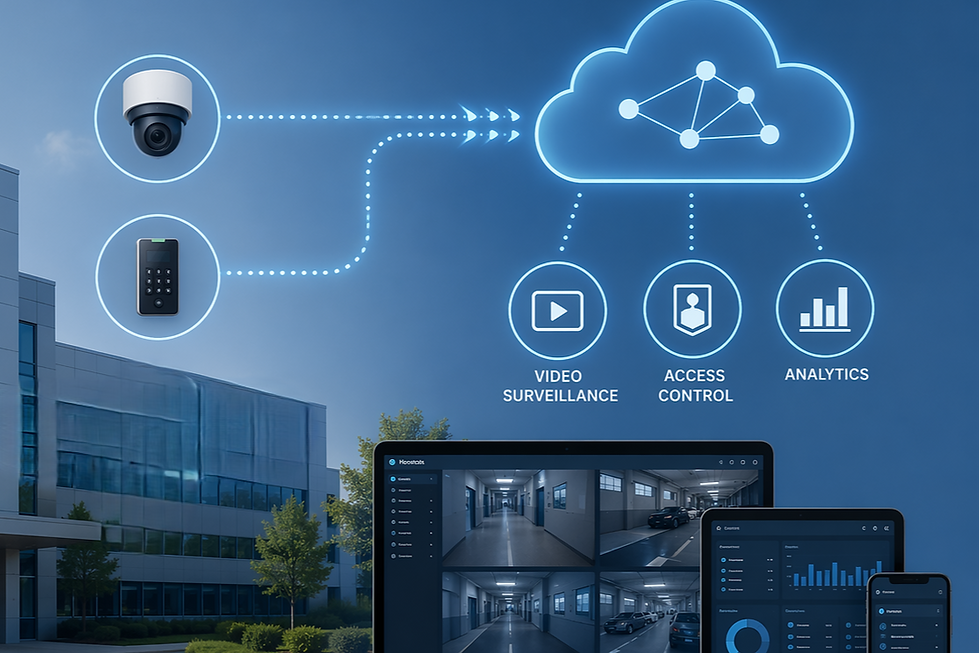
The migration of security systems to the cloud is accelerating across healthcare, with a significant portion of organizations moving video surveillance, access control, and analytics platforms off-premise. This transition is not just about technology—it’s a strategic shift in how security operations are managed.
Cloud-based security platforms provide immediate advantages in scalability and accessibility. Multi-site health systems can centralize operations, allowing security teams to monitor facilities, manage access permissions, and respond to incidents from virtually anywhere. This is particularly valuable in large networks where standardization and oversight are challenging with on-premise systems.
From a technical perspective, cloud environments reduce the burden of maintaining physical servers, storage arrays, and software updates. System patches, feature enhancements, and cybersecurity protections are managed by the provider, ensuring that environments remain current without requiring internal resources to execute upgrades.
Another key advantage is data resilience. Cloud platforms typically offer redundancy, failover capabilities, and disaster recovery mechanisms that are difficult and expensive to replicate on-premise. In a healthcare environment where uptime is critical, this added reliability directly supports patient safety and operational continuity.
Financially, cloud adoption shifts capital expenditure (CapEx) to operational expenditure (OpEx), providing more predictable cost structures. Organizations can scale usage based on need rather than overbuilding infrastructure to accommodate peak demand.
However, cloud adoption must be approached with a strong governance framework. Security leaders should work closely with IT to ensure compliance with healthcare regulations, implement robust identity and access controls, and validate that vendors adhere to industry security standards.
Lifecycle Management Systems: Closing the Gaps Before They Become Risks
While cloud platforms enhance visibility and control, lifecycle management systems address a different—but equally critical—challenge: maintaining the integrity and performance of security hardware over time.

Healthcare environments often operate thousands of connected devices—cameras, badge readers, servers, sensors, and controllers—each with its own firmware, maintenance schedule, and end-of-life timeline. Without a structured approach, these assets can quickly become outdated, vulnerable, or non-compliant.
Platforms such as Securithings are designed to bring order to this complexity. These systems provide centralized visibility into all security assets, tracking installation dates, warranty status, firmware versions, and maintenance history. More importantly, they enable proactive management.
Automated firmware updates are a key capability. Outdated firmware is one of the most common vulnerabilities in security infrastructure, particularly for IoT-enabled devices. Lifecycle management platforms can identify devices running outdated versions and deploy updates systematically, reducing exposure without requiring manual intervention.
In addition, these tools support preventive maintenance by generating alerts for upcoming service needs or identifying performance degradation trends. For example, a camera with declining image quality or intermittent connectivity can be flagged before it fails entirely—minimizing downtime and avoiding blind spots in coverage.
From a compliance standpoint, lifecycle documentation provides an auditable record of maintenance and updates, which is increasingly important in regulated healthcare environments.
Strategic Alignment: From Reactive Maintenance to Proactive Optimization
The intersection of cloud-based security and lifecycle management represents a broader evolution in healthcare security strategy. Organizations are moving away from reactive, break-fix models toward proactive, data-driven operations.

Cloud platforms deliver the infrastructure and analytics needed for real-time visibility and centralized control. Lifecycle management systems ensure that the underlying hardware remains secure, current, and fully operational. Together, they create a continuous improvement loop—where performance data informs maintenance, and maintenance sustains performance.
For healthcare leaders, the takeaway is clear: modern security is not just about deploying technology—it’s about managing it intelligently over time. By embracing cloud adoption and lifecycle management, organizations can reduce risk, improve efficiency, and ensure that their security posture keeps pace with an increasingly complex threat landscape.

Dylan Hayes is a 25-year physical security technology expert and previously acted as the physical security program leader for Seattle Children’s Hospital and Research Institute. He managed teams, operations, and technology that transformed the culture of safety and experience for staff, visitors, and patients. Currently, he is Security Solutions NW Healthcare Consultant.


Comments